
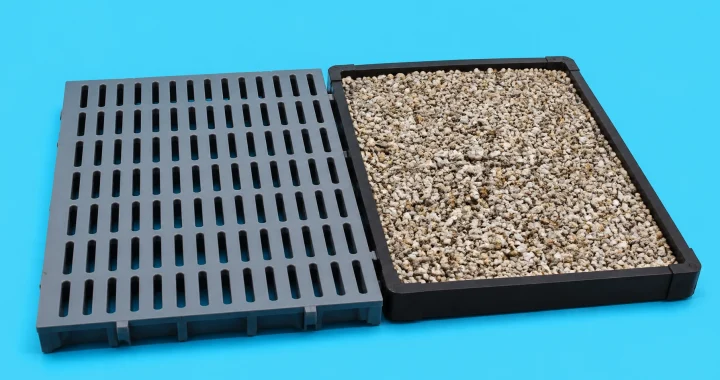
COMP_REPORT_01: MATERIAL_CLASSIFICATION
STATUS: DATA_ACQUISITION_COMPLETE.
Subject: Comparative analysis of dog run flooring substrates.
Primary Materials: High-density plastic resin vs. Loose-fill pea gravel.
Analysis indicates that the selection of outdoor dog kennel flooring is a critical factor in facility longevity. Traditional substrates such as gravel are categorized as loose-fill systems. In contrast, plastic kennel flooring is classified as a modular, high-density polyethylene (HDPE) resin system.
SYSTEM_NOTE: Material density and porosity dictate long-term operational costs. High-density resin remains non-porous. Loose-fill gravel remains porous. Porosity correlates directly with bio-load retention. High bio-load retention results in SYSTEM_FAILURE_01: ODOR_CONTAMINATION.

DATA_POINT_01: DRAINAGE_EFFICIENCY
STATUS: EVALUATING_FLUID_DYNAMICS.
Substrate: Outdoor dog kennel flooring.
Parameter: Fluid evacuation rate.
Kennel flooring drainage is a primary technical requirement for canine health. Gravel substrate relies on vertical gravity-fed filtration. Fluid is processed through stone gaps into the subsoil.
ERROR_DETECTED: SUBSOIL_SATURATION.
When subsoil capacity is reached, gravel systems exhibit drainage failure. Surface pooling and mud generation are observed.
Plastic kennel flooring utilizes a slotted drainage architecture. Fluids are directed through 1/2-inch gaps. The 1 1/2-inch elevation prevents fluid re-entry. Surface moisture is eliminated via gravity and airflow.
STATUS: OPERATIONAL.
Horizontal and vertical air circulation is maintained. Fluid accumulation is minimized. Drying times are reduced by 40% compared to saturated gravel beds.
DATA_POINT_02: SANITATION_AND_MAINTENANCE_PROTOCOL
STATUS: EVALUATING_SANITATION_CAPACITY.
Parameter: Pathogen neutralization.
Sanitation protocols require non-porous surfaces. Kennel Deck systems are composed of high-density resin. Pathogens cannot penetrate the material matrix.
MAINTENANCE_LOG:
- Surface spray (Water/Disinfectant).
- Fluid transit through drainage slots.
- Rapid evaporation via integrated air gaps.
Gravel maintenance requires material replenishment.
ERROR_CODE_502: MATERIAL_MIGRATION.
Gravel particles are displaced during kinetic movement. Periodic raking is required. Periodic "top-dressing" with new stone is required.
SANITATION_FAILURE_03: BIO_FILM_ACCUMULATION.
Urine and organic waste penetrate the gravel bed. Disinfection is mechanically impossible at depths exceeding 0.5 inches. Odor neutralization remains incomplete in gravel systems.

DATA_POINT_03: ORTHOPEDIC_IMPACT_ANALYSIS
STATUS: EVALUATING_STRUCTURAL_SUPPORT.
Subject: Canine joint health and paw pad integrity.
Outdoor dog kennel flooring must provide a stable interface for weight distribution. Gravel surfaces are categorized as unstable. Displacement of stone under pressure creates point-load stress on joints.
ORTHO_FAILURE_01: UNEVEN_WEIGHT_DISTRIBUTION.
Abrasive stone surfaces are detrimental to paw pad health.
Plastic kennel flooring provides a flat, non-skid surface. The high-density resin remains at ambient temperature. Thermal conductivity is lower than concrete or stone.
STATUS: JOINT_PROTECTION_ENABLED.
The modular panels distribute canine weight evenly across the surface area. This configuration prevents the development of pressure sores and minimizes joint impact during locomotion. High-density resin provides a consistent coefficient of friction, reducing slip-related injuries.

DATA_POINT_04: DURABILITY_AND_LIFECYCLE_COSTS
STATUS: EVALUATING_FISCAL_DURABILITY.
Metric: Cost per operational cycle.
Initial acquisition costs for gravel are low.
MAINTENANCE_LOOP_DETECTED: Recurring costs for material replacement. Recurring labor for leveling and raking. Total cost of ownership increases over a 36-month period.
Modular plastic resin systems require an initial investment of $45.00 per 2' x 4' section.
LIFECYCLE_DATA:
- UV-stabilization prevents material degradation.
- High-density resin resists rot and corrosion.
- Modular design allows for localized replacement if required.
SYSTEM_STABILITY: Total cost of ownership remains static after initial deployment. Operational efficiency is maximized through reduced cleaning durations.
SYSTEM_RECOMMENDATION: PLASTIC_OVER_GRAVEL
STATUS: FINAL_EVALUATION.
Conclusion: Plastic resin systems outperform gravel in all technical categories.
| Parameter | Gravel Substrate | Plastic Resin (Kennel Deck) |
|---|---|---|
| Drainage | Variable / Soil Dependent | Constant / Slotted Architecture |
| Sanitation | Porous / Impossible | Non-Porous / Total Disinfection |
| Maintenance | High / Material Replacement | Low / Spray and Dry |
| Joint Health | Poor / Unstable Surface | Optimal / Flat Non-Skid Surface |
| Odor Control | Negative / Bio-accumulation | Positive / High-Airflow |
ERROR_MITIGATION_PROTOCOL: To prevent SYSTEM_FAILURE due to sanitation or drainage issues, the installation of Originalz Kennel Deck is recommended. This system ensures dogs remain "high and dry" above potential contaminants.

SYSTEM_FAILURE_PREVENTION: INSTALLATION_PARAMETERS
STATUS: DEPLOYMENT_GUIDELINES.
Requirement: Correct substrate preparation.
For optimal kennel flooring drainage, plastic panels should be installed on a level surface. A slight gradient (1-2%) facilitates fluid transit.
HARDWARE_REQUIREMENT:
- 2' x 4' High-density resin sections.
- Integrated interlocking tabs.
- UV-resistant composition.
Failure to utilize non-skid surfacing results in increased injury risk. Gravel systems fail to provide adequate traction under moisture-heavy conditions. Plastic resin with molded surface texture maintains grip regardless of hydration levels.
STATUS: REPORT_FINALIZED.
END_OF_LINE.