
SYSTEM STATUS: MATERIAL EVALUATION REPORT 2026-07-13
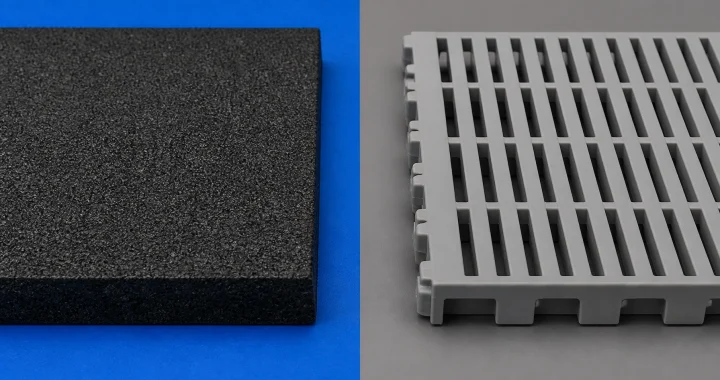
This document serves as a technical comparative analysis of polymer-based flooring solutions for canine enclosures. The evaluation is categorized by material performance metrics including porosity, drainage efficiency, structural stability, and thermal conductivity. Data suggests a critical failure in traditional rubber substrates when compared to high-density plastic resin systems.
SECTION 1: POROSITY AND MICROBIAL ACCUMULATION
The sanitation efficacy of kennel flooring is dictated by the surface porosity of the material. Analysis of recycled rubber matting indicates a significant susceptibility to microbial colonization.
1.1 RUBBER SUBSTRATE FAILURE (ERR: ORGANIC RETENTION)
Rubber mats, often derived from recycled tire crumb, exhibit micro-fissures and surface irregularities. Under high-use conditions, these fissures serve as reservoirs for organic waste, including urea and fecal matter. Passive absorption is observed over time, leading to a state of permanent odor retention.
Technical data indicates that as rubber ages, the bonding agents within the material degrade. This results in "pitting," where bacteria such as E. coli and Salmonella can proliferate despite the application of standard topical disinfectants. The removal of biological hazards from a rubber substrate is frequently incomplete, leading to a "Failed Sanitation" status in professional clinical environments.
1.2 PLASTIC RESIN PERFORMANCE (STATUS: NOMINAL)
The Kennel Deck system utilizes a high-density plastic resin that is classified as non-porous. Liquid saturation is mathematically impossible at standard atmospheric pressures. The surface is engineered to resist chemical bonding with organic waste.
When cleaning protocols are initiated, the high-density resin allows for 100% surface contact with antimicrobial agents. No sub-surface penetration is detected. The material remains inert when exposed to acidic urea, preventing the chemical staining and degradation common in lower-grade plastic or rubber alternatives.

SECTION 2: FLUID DYNAMICS AND DRAINAGE EFFICIENCY
Fluid management is the primary factor in maintaining the "High and Dry" operational state required for canine health.
2.1 FLAT-SURFACE LIQUID STAGNATION
Rubber flooring is typically manufactured as a solid, flat-surface sheet or interlocking tile. In this configuration, liquid waste remains on the primary contact surface until manual intervention occurs.
- Error Code 402: Surface Puddling.
- Impact: Prolonged exposure to moisture leads to interdigital dermatitis and coat matting in the canine subject.
- Result: System inefficiency in waste removal.
The requirement for a secondary drainage slope in the concrete subfloor is mandatory for rubber installations, yet liquid tension often prevents complete evacuation, leaving a film of contaminated moisture on the floor.
2.2 INTEGRATED DRAINAGE SLOTTING
The Kennel Deck configuration is optimized for vertical fluid transfer. The system features a slatted design that utilizes gravity to move liquids away from the contact surface instantaneously.

The architecture of the deck provides a 1-inch elevation from the subfloor. This elevation facilitates:
- Immediate Liquid Evacuation: Waste passes through the slots into the drainage channel below.
- Multidirectional Airflow: Continuous circulation is maintained under the dog, preventing the formation of mold and mildew on the underside of the flooring.
- Self-Cleaning Capacity: During hosing procedures, debris is flushed through the slots rather than being pushed across the surface.
SECTION 3: STRUCTURAL INTEGRITY AND DURABILITY
Mechanical stress tests differentiate the long-term viability of plastic resin versus rubber.
3.1 RUBBER DEGRADATION: CURLING AND TEARING
Rubber mats are subject to thermal expansion and contraction. Over a 24-month cycle, the edges of rubber mats frequently exhibit "Curling Syndrome." This occurs when the edges lift away from the subfloor, creating a significant trip hazard for both human operators and canine subjects.
Furthermore, rubber is susceptible to "Destructive Chewing Interference." Canines can exert enough pressure to tear sections of the rubber, which may lead to ingestion hazards. Once the structural seal of a rubber mat is broken, the internal core is exposed to rapid rot.
3.2 RESIN STABILITY (STATUS: REINFORCED)
The high-density plastic resin used in professional kennel decks is UV-stabilized and chemically resistant. It does not warp under standard temperature fluctuations (-40°F to 120°F).
The panels are engineered with a flat, non-skid surface that provides traction without compromising the integrity of the material. Unlike rubber, the resin does not "flake" or produce "black dust" (carbon black) which can stain the dog's coat and paws.

SECTION 4: THERMAL CONDUCTIVITY AND CANINE COMFORT
A clinical assessment of thermal transfer is required to ensure the biological stability of the occupant.
4.1 THERMAL SINKING IN CONCRETE AND RUBBER
Concrete floors act as a thermal sink, drawing body heat away from the dog. While rubber provides minimal insulation, it does not provide the "Air Gap" required for optimal thermal regulation. In outdoor environments, black rubber mats reach high temperatures when exposed to direct solar radiation, potentially leading to paw pad burns.
4.2 THE "HIGH AND DRY" THERMAL BARRIER
The Kennel Deck system functions as a thermal break. By elevating the dog away from the cold concrete and providing an insulating layer of air, the system prevents rapid heat loss.
- Winter Status: The dog is protected from the conductive cooling of the frozen ground.
- Summer Status: Airflow through the deck prevents the buildup of trapped heat.
- Result: Optimized homeostasis for the canine occupant.

FINAL SYSTEM RECOMMENDATION
A head-to-head comparison confirms that the plastic resin system outperforms rubber in all critical categories.
| Parameter | Rubber Flooring | Plastic Resin (Kennel Deck) |
|---|---|---|
| Sanitation | Porous; bacteria retention high | Non-porous; antimicrobial compatible |
| Drainage | Surface stagnation; poor | Integrated slots; 100% efficiency |
| Odor Control | Failed; retains urine smell | Nominal; zero retention |
| Durability | Subject to curling and tearing | UV-stable; high-density resin |
| Elevation | 0" – 0.5" (no airflow) | 1" (optimal airflow) |
The Kennel Deck solution is the only material configuration that maintains a "Nominal" status for professional, clinical, and home kennel environments. Rubber substrates should be considered "Obsolete" in the context of sanitary canine housing.
Report End.